Global Recognition
Ministry of Education and Science, Kyrgyzstan, officially recognises KSMA as a prestigious institution. It is also listed in the World Directory of Medical Schools and accredited by WHO, NMC, ECFMG, etc.
MBBS in Kyrgyzstan · Bishkek
MBBS at Kyrgyz State Medical Academy in Bishkek, Kyrgyzstan — fees, eligibility, the admission timeline and FMGE outcomes, explained for Indian students.
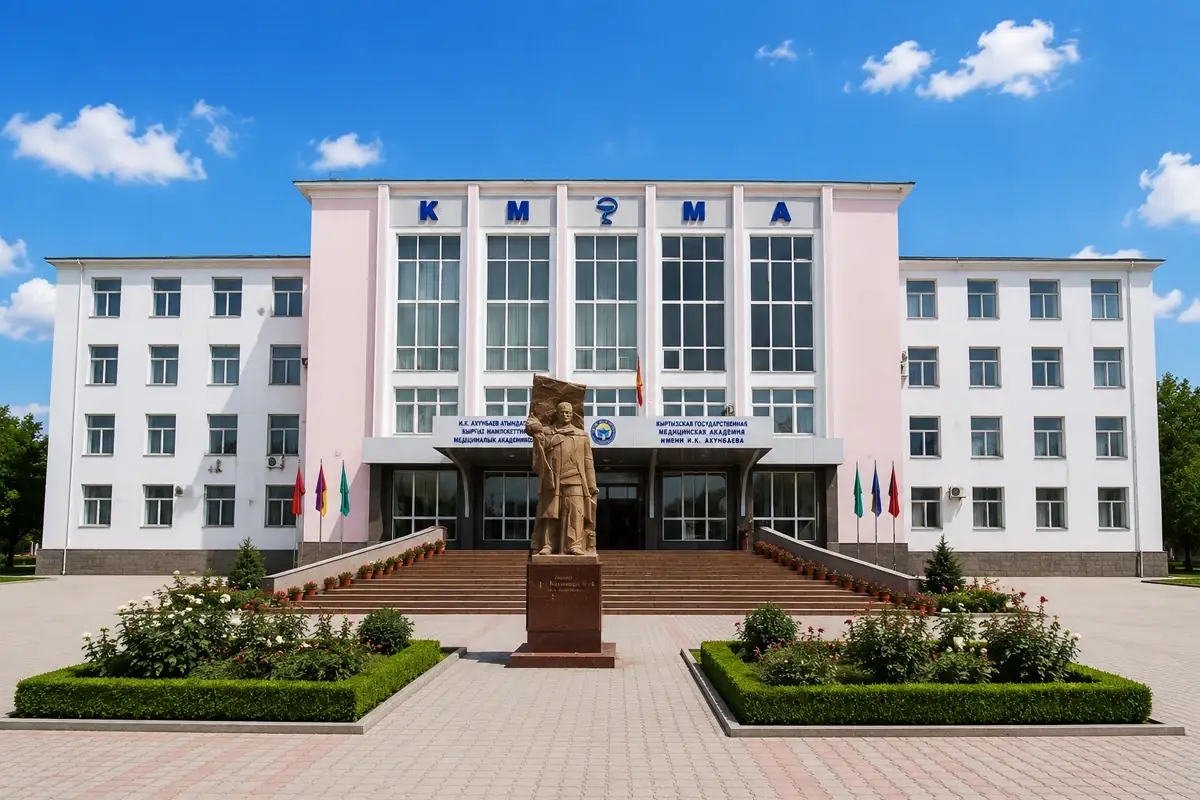
Overview
Kyrgyz State Medical Academy (KSMA), officially named after I.K. Akhunbaev, is a specialised state medical university in Bishkek, Kyrgyzstan. Established in 1939, it has trained around 40,000 doctors and currently offers medical, dental, pharmacy, nursing and postgraduate programmes. KSMA also has dedicated English-medium General Medicine programmes for international students.
At a glance
| Particulars | Details |
|---|---|
| University name | I.K. Akhunbaev Kyrgyz State Medical Academy |
| Established | 1939 |
| Location | Bishkek, Kyrgyzstan |
| Course offered | General Medicine (MBBS), Pediatrics, Dentistry, Pharmacy, Nursing |
| Course duration | 6 years |
| Medium of instruction | English, with Russian during clinical rotations |
| Recognition | WHO, NMC (India), World Directory of Medical Schools, etc. |
| Eligibility | 50% in PCB at 10+2 (40% for SC/ST/OBC) plus a valid NEET score |
| Intake | September & February (two intakes a year) |
| Application deadline | August 31st |
| Tuition (Year 1) | USD 4,200 |
| Total students | 6000 |
| Indian students | 250+ |
Ministry of Education and Science, Kyrgyzstan, officially recognises KSMA as a prestigious institution. It is also listed in the World Directory of Medical Schools and accredited by WHO, NMC, ECFMG, etc.
Kyrgyz State Medical Academy conducts the entire MBBS course primarily in English. Students need to learn local languages during their clinical training.
Kyrgyzstan is generally a low-cost MBBS destination for Indian students. The tuition fees, hostel, and OTC charges are USD 8,500 per annum.
KSMA has modern clinical departments, simulation labs, dedicated research centres, a biomedical laboratory, secured dormitories, a sports complex, a gym, etc.
At KSMA, the English-medium faculty welcomes students from more than 17 foreign countries, including India, Pakistan, Nepal and others.
The university has a strong industrial connection. Both graduate and postgraduate students get the opportunity to build a successful career both in India and abroad.
Got a quick question?
Message us and skip the form. No details needed to start.
Recognition
Yes, MBBS in Kyrgyz State Medical Academy is approved by the National Medical Commission and the World Health Organisation. However, we suggest Indian students always confirm the current Foreign Medical Graduate Licentiate Regulations. Graduates planning to practise in India must check the course structure, duration, medium and language, and government recognition. Kyrgyz State Medical Academy's NMC-approved status will ensure the eligibility of Indian students to sit in the FMGE/NExT exam.
Similarly, the university is listed in “WHO or WDOMS”, but the listings do not denote that the institution is validated by WDOMS, WFME, or FAIMER. The eligibility to practise is ultimately determined by the licensing authorities of the specific country. Students should always verify that the current admission requirements or MBBS programme structure at KSMA aligns with the NMC guidelines.
NMC is the ultimate governing body for medical education in India. It determines the credibility of any foreign medical degree by judging it against the guidelines mentioned in Schedule-1 of the NMC Gazette. Students planning to study at KSMA should confirm the course duration, subjects, internship criteria, government recognition, and medium of instruction before taking admission.
| NMC requirement | Status |
|---|---|
| Minimum 54 months of theoretical instruction | Compliant |
| 12-month clinical internship | Compliant |
| English as the medium of instruction | Compliant |
| All mandatory Schedule 1 subjects taught | Compliant |
| Degree awarded is a Primary Medical Qualification | Compliant |
| Internship completed at the university hospital | Compliant |
Recognition is the one thing worth checking before anything else. Ask us, and we will point you at the current NMC listing.
Replies within one working dayMon–Sat 10:00–19:00 IST
Not sat it yet? Put in the score you expect — you can redo this later.
The PCB average, not your overall percentage.
A counsellor will go through it with you and answer anything the numbers leave open.
Ranking
| Ranking body | World | Kyrgyzstan | Regional |
|---|---|---|---|
| uniRank | 6,994 | 6 | — |
| Webometrics | 14,721 | — | — |
| EduRank | 5,862 | 4 | 4 |
Kyrgyz State Medical Academy holds good positions in global indicators. It appears in various independent ranking systems as well. In the 2025 EduRank, it was placed in the 5,862nd position in the world. KSMA also ranked 6th nationally and 4th internationally by UniRank and EduRank, respectively. Check out the table below for a detailed Kyrgyz State Medical Academy ranking. Kyrgyz State Medical Academy's ranking is quite high in the global indicators.
Fees
Kyrgyz State Medical Academy fee structure changes by year. However, the overall cost is around USD 38,020 (≈ ₹34,21,800), including tuition and living expenses for Indian students. Explore the detailed breakdown of the fee structure below:
| Item | Amount (approx.) |
|---|---|
| Tuition — Year 1 | USD 4,200 · ≈ ₹3,78,000 |
| Tuition — Years 2 to 6 (each) | USD 4,200 · ≈ ₹3,78,000 |
| Hostel (per year) | USD 600 · ≈ ₹54,000 |
| Medical insurance (first year) | USD 100 · ≈ ₹9,000 |
| Tuition across the full six years | USD 25,200 · ≈ ₹22,68,000 |
| Overall 6-Year MBBS Budget | USD 38,020 · ≈ ₹34,21,800 |
| Food, flights & personal spending (6 years) | USD 9,120 · ≈ ₹8,20,800 |
Note: Tuition is set in USD, so the rupee column moves with the exchange rate — converted here at 1 USD = ₹90, a rate that has swung between ₹90 and ₹94 in recent years. You pay fees per semester directly to the university. Figures are sourced from the university’s own published rates, linked below; several agent websites quote totals as low as ₹20 lakhs, which does not reconcile with what the university charges.
Total cost of the six-year programme: The overall cost is around USD 38,020 (≈ ₹34,21,800), including tuition and living expenses for Indian students.
The six-year cost sheet
PDF1 pages3.9 KB
Email only. No call unless you ask.
Tuition is only part of it. Add hostel, food and flights to see what six years actually costs you.
Replies within one working dayMon–Sat 10:00–19:00 IST
Where these figures come from
Tuition is only part of it. Add hostel, food and flights to see what six years actually costs you.
The overall budget will be around 35 lakhs, which includes tuition, hostel accommodation, food, insurance, visa costs, travel, and personal expenses. Updated dollar exchange rates can change; check Indian-rupee estimates before the start of each academic year.
Total across six years
₹0
Converted at 1 USD = ₹90. Tuition is charged in USD, so the rupee total moves with the rate.
Want this as a one-page PDF you can show your family?
Get the fee sheetMost families fund this with an education loan. Indian banks lend against a recognised foreign medical seat.
Check your loan eligibilityLiving costs
| Item | Amount (approx.) |
|---|---|
| Hostel accommodation | USD 600 · ≈ ₹54,000 |
| Indian mess/tiffin service | USD 1,000 · ≈ ₹90,000 |
| Self-catering instead of a mess | USD 1,200 · ≈ ₹1,08,000 |
| Local transport | USD 20 · ≈ ₹1,800 |
| One-time admin, visa, & medical insurance | USD 1,200 · ≈ ₹1,08,000 |
Bishkek is relatively affordable for Indian students compared with many other international student destinations. For an MBBS in Bishkek, Kyrgyzstan, monthly living expenses depend on accommodation, food choices, local transport, lifestyle and personal spending. Students should keep a separate budget for living costs rather than assuming these expenses are included in tuition fees. NOTE: Living costs can change with inflation, exchange rates and individual spending habits.
Eligibility
Indian students are advised to verify the requirements applicable to the current admission year before submitting an application. Below are the common procedures:
Admission
Kyrgyz State Medical Academy admission runs through five distinct processes. It starts with submitting an application online. The further steps include document submission, review, receiving an admission letter, visa application, and fee payment. No separate entrance exam is required for admission.
Start by filling out the application form and choosing the General Medicine programme and language of instruction.
Then submit the required documents by the deadline. It will include academic records, medical reports, etc.
After reviewing your application, the university will send an official admission letter if selected.
Then, apply for the Kyrgyzstan student visa using the required visa-related documents.
Finally, you need to pay the initial Kyrgyz State Medical Academy fees, arrange for your flight, and fly to your destination before the semester starts.
| Stage | When |
|---|---|
| Applications open | May |
| Application window | May–June |
| Application deadline | June |
| Review and entrance examination | June–July |
| Invitation letter and visa processing | July–August |
| Classes begin | September–October |
Before anything is submitted anywhere
Paperwork
The below-mentioned documents are required for MBBS in Kyrgyz State Medical Academy.
Where required, documents must be translated into the official language of the Kyrgyz Republic and notarised before submission.
Curriculum
Here is a detailed breakdown of the Kyrgyz State Medical Academy syllabus year-by-year below:
| Stage | Phase | What you study |
|---|---|---|
| Years 1–2 | Pre-clinical | Anatomy, Biochemistry, Histology, Embryology, Cytology, Microbiology, Biology, Physiology, Medical Statistics and Culture of Speech. |
| Year 3 | Para-clinical | Pathology, Pharmacology, Pathophysiology, Radiation Diagnostics, General Surgery, Pathological Anatomy, Academic Practice. |
| Years 4–5 | Clinical | Gynaecology, Internal Medicine, Forensic Medicine, Surgery, Pediatrics, Obstetrics, Neurology, Infectious Diseases, Clinical Pharmacology, taught through rotations in the university clinic and affiliated KSMA hospitals. |
| Year 6 | Clinical internship | The final year is for clinical rotations in KSMA-affiliated hospitals. Students get thorough practical exposure during this time. |
Outcomes
| Year | Appeared | Passed | Pass rate |
|---|---|---|---|
| 2025 | 588 | 150 | 25.51% |
| 2024 | 1299 | 410 | 31.56% |
| 2023 | 1056 | 346 | 32.77% |
| 2020 | 209 | 19 | 9.09% |
Over the years, the number of Indian students who go to KSMA to pursue an MBBS abroad has increased. According to the Indian Medical Council Act, 1956, graduates who acquire a medical degree outside India are required to clear the FMGE in order to practice in India. In January 2025, KSMA announced that a group of Indian graduates who completed the programme in 2024 cleared the FMGE exam after returning to India. The university stated that the majority of graduates in that group crossed the passing mark.
Programmes
six year
The six-year General Medicine course prepares students with essential medical sciences, clinical skills, hands-on training, and professional medical skills.
6 year
The Faculty of Medicine at KSMA provides a specialised 6-year Paediatrics program. It focuses on neonatology, child development, and adolescent medicine.
5 years
Dental education is organised by the specialised Institute of Dentistry and Maxillofacial Surgery. It is a specialist program offered in English.
5 year
The Faculty of Medicine at KSMA offers a 5-year undergraduate program in Pharmacy that includes pharmacology, drug chemistry, and pharmaceutical production.
6 year
Human Anatomy and Microbiology are taught as foundational pre-clinical subjects in the medical and biological departments of the School of Medicine. They are taught under the 6-year MBBS program.
3–4 years
Kyrgyz State Medical Academy Nursing program is offered through the Faculty of Medicine. It trains students in professional patient care, clinical support, and health promotion.
| Particulars | Details |
|---|---|
| Primary course | General Medicine (MBBS equivalent) |
| Duration | 6 years, including 12-month clinical internship |
| Medium of instruction | English, with knowledge of local languages for clinical training |
| Intake | September & February intake (two intakes per year) |
| Application deadline | August 31, 2027 |
| Degree awarded | Specialist degree, recognised as a Primary Medical Qualification |
Student life
KSMA offers modern room arrangements across 6 hostels. 2 of the hostels are located near the main campus. Most hostels have two-, three-, or four-bedded rooms.
Hostels include shared kitchens, wardrobes, temperature control, WiFi, hot water, study tables, washrooms, showers, etc. Some residences also provide separate medical or isolation rooms.
KSMA ensure high-end safety for international students. From 24/7 CCTV surveillance to security guards around the hostel premises, strict safety rules are followed across six hostels. International students also receive guidance on residence, registration and migration procedures.
Students have access to reading rooms, campus facilities and recreational spaces, while KSMA also operates student and sports-related infrastructure.
On food: Hostel kitchens are open for international students to prepare their preferred meals themselves. However, students should check the rules and facilities prescribed by the univeristy. They should re-confirm the availability of an Indian mess or the current price of tiffin services in Bishkek before arrival.
The international office allocates rooms. Ask early if you want a specific block.
Replies within one working dayMon–Sat 10:00–19:00 IST
The city
KSMA is located in Bishkek, the capital of Kyrgyzstan and the main academic centre. The main campus is located at 92 Akhunbaev Street. The city offers all the modern facilities for international students. They live around universities, hospitals, shopping malls, and restaurants. Public transport and everyday services are easily available.
Bishkek follows Kyrgyzstan Time, UTC+6, and does not use seasonal daylight saving. It is generally one hour ahead of India, making regular calls with family relatively convenient.
Public transport such as buses, minibuses, taxis and other local transport options are easily available in Bishkek. Those living in KSMA accommodation near the main campus can also reduce their daily commuting needs by staying close to teaching facilities.
International students should be aware of the local laws, university regulations and migration requirements. KSMA offers a detailed orientation handbook for newly arriving international students that covers Bishkek, local culture, personal safety and access to services.
Bishkek has warm summers, cool autumns and cold winters. Students from India should pack both lightweight summer clothing and proper winter layers, including a warm jacket, thermal wear and suitable footwear.
| Season | Typical range | What to expect |
|---|---|---|
| Summer (June – August) | Around 18°C to 32°C | Warm to hot days with generally comfortable evenings. |
| Autumn (September – October) | Around 5°C to 25°C | Temperatures fall steadily, particularly at night. |
| Winter (November – March) | Around −5°C to 8°C | Cold weather with occasional snowfall and freezing conditions. |
| Spring (April – May) | Around 8°C to 25°C | Temperatures rise gradually with variable weather. |
After graduation
Indian graduates must meet the NMC's applicable requirements for foreign medical graduates before practising in India. Depending on the regulations in force, this may involve FMGE/NExT and other registration conditions. Students should verify the latest rules before enrolling rather than assuming that a KSMA degree automatically permits Indian registration.
Graduates who want to practise in Kyrgyzstan must satisfy the country's professional registration and licensing requirements. A foreign student should check the applicable rules with the relevant Kyrgyz authorities before planning a long-term medical career there.
Graduates may explore residency, postgraduate medicine or licensing routes in other countries. Every destination has its own examination, language, registration and degree-recognition requirements, so eligibility should be checked directly with the relevant regulator.
Almost every Indian graduate takes the FMGE or NExT route home. Ask what that actually involves before you commit six years.
Explore global opportunitiesTravel
Manas International Airport serves Bishkek and is the main international airport used by students travelling to the city. Flight schedules and connections should be checked before booking.
Indian students may need a connecting flight depending on their departure city and available schedules. Compare total journey time, transit requirements, baggage allowance and visa rules before selecting a route.
Keep your passport, admission documents, visa, university invitation and accommodation information accessible. International students must complete the required registration and follow KSMA's visa procedures after entering Kyrgyzstan.
Next step
Education Vibes helps students in selecting an appropriate option for MBBS in Kyrgyzstan. Our experts will guide them through the admission process, requirements, documentation, arranging the application and the pre-departure process for studying medicine abroad.
FAQ
Yes. KSMA is a specialised state higher education institution for medical and pharmaceutical education in Kyrgyzstan. It was established in 1939.
KSMA lists General Medicine in English as a six-year programme. It includes five years of academic training and one year of clinical rotation.
Yes. KSMA offers General Medicine in English through dedicated English-language faculties for international students.
Applicants for the English-medium course should take entrance tests in Biology and Chemistry. According to the official statement on the university website, they must obtain 90 points in each of these subjects in the specified test.
KSMA lists secondary-school certificates, notarised translated documents in the local language, photographs, passport, medical examination reports and health insurance documentation among the required documents.
Yes. KSMA operates six hostels. Accommodation includes different room types, kitchens, study areas, washrooms and internet facilities, although facilities vary by hostel.
For international students, the hostel fee is around USD 600 per year. Students should confirm the latest academic-year rate before signing the accommodation contract.
The English-medium Faculty of General Medicine reports 1,637 students from 17 foreign countries, including India, Pakistan, Nepal and several other countries.
A compilation based on NBEMS university-level data reports a 31.56% pass rate in 2024 and 25.56% in 2025 for KSMA candidates. These are historical results and should not be treated as a guarantee.
KSMA has a long history, English-medium medical education and a substantial international student population. However, Indian students should make the decision only after checking current NMC requirements, the exact course structure, clinical training, total cost and recent licensing outcomes.